Showing posts with label review. Show all posts

Tuesday, December 8, 2020

Review: Shimano SH-XM9 gore-tex touring cycling shoe

 Just a short 11 years ago, I reviewed the Lake winter cycling shoes. The Lakes are warm boots that were best at very cold and dry conditions. Anything else (i.e. rain/wet) and they're not so great. Their Boa lacing system is one that either you love or hate -- I still think they're solving a problem in bike shoes that don't need to be solved as they do with ski boots. So there. Oh yeah, and the Lake boots don't pass the "may look nerdy, but not bike nerdy" test. 

Enter the Shimano SH-XM9 winter cycling shoe. I got this pair last year and I've given them a sound beating. I'm ready to share my thoughts...

tl;dr

I love em. In all the ways I was disappointed by the Lake shoes, I've been impressed and delighted by the Shimano boots. (They're labeled "shoes" -- by what metric do these meet that definition?)


Let's start with basics: they have laces. That is the correct, proper, and a well-understood way to fasten your boots tightly. Centuries of shoe-tyers can't be wrong! Laces work! Laces Out!

The boots have a webbing strap at the ankle that hold the laces -- coupled with open lace hooks above the ankle and magically strong laces, suffering through the ancient task of manually tying the boots is mercifully efficient. And of course there's a stretchy lace-keeper where you can stuff your tied laces.


As for the "blend in effect" -- they do ok. One thing I always like to find are clothes and shoes that are pretty normal looking and will wear fine in most casual contexts. Although I no longer commute, I still appreciate being able to wear bike-useful clothes as a default mode. This approach makes hopping on the bike for a spin much less of a ritualized event.

I especially don't want to be bikey guy with weird shoes that can barely walk or that looks like Flash Gordon. So while these are some generically damn nerdy looking boots, they're not bike-specifically damn nerdy, and that tiny sliver of difference is all it takes!


Cold? check. Wet? check. Even warm and summer? works -- a bit steamy, but passable. I'm not gonna carry on about the magic that is Gore-tex, because I bowed down long ago. There's a lot of snake-oil charleton bullshit claims of "breathable AND warm when wet" that are just bunk. Gore-tex -- especially in footwear, puts out. 

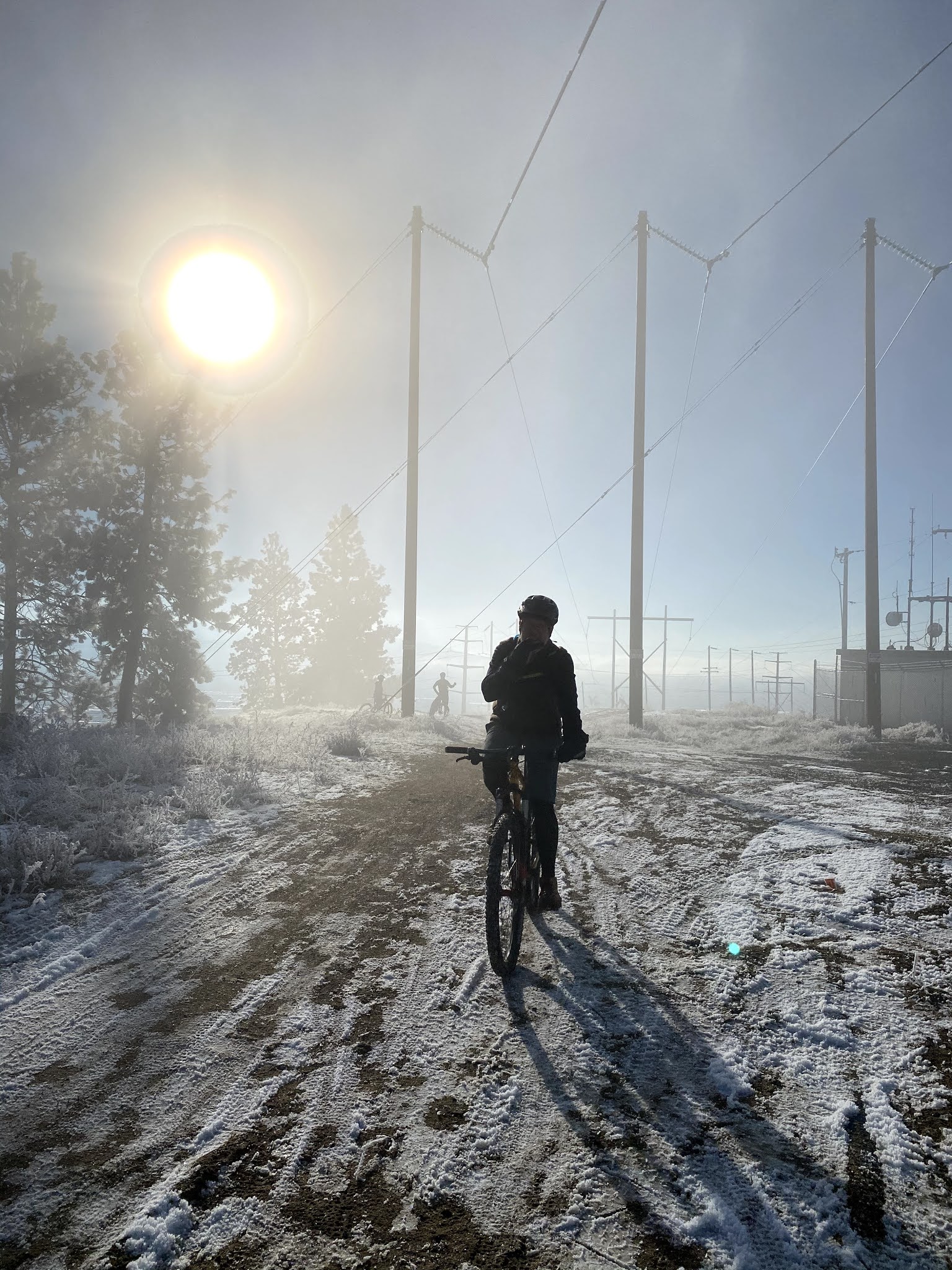
I wear two layers of thin wool dress socks with these suckers and I'm always warm. Pic above is buddy Joe at about 25F on top of Beacon Hill. This is proof that I've been outside with these boots when it was cold. 

For rain -- I learned in a misery fest ride in early fall on a rainy-assed climb on the Kettle Crest Trail that I need to make sure the upper cuff is tented with pants or god-forbid gaiters.


See -- that's a normal nerd look. Not a bike-specific nerd look. Boom. They look good after a year's worth of service. And while I don't wear them a lot, when I do, the conditions are either cold or sucky or both. So these guys mostly get hard use. They're wearing well. As they should. They retail for like $200. But looks like you can find them for around $150. Very worth it.


Of course they're SPD (and other lesser cleats) compatible. That's an obvious requirement. 

But guess what else: they actually wear like a normal boot. If you could get over the extra crunching and screeching brought on by hiking over rocks with an SPD cleat installed, you could do actual, real hiking in these. 

Of course, I make this claim as one who is no fan of walking and disdains hiking. Especially up hill: what's the bloody point? you can't even coast down. Nevertheless, a guy could use these to hike, they're comfy and provide manly support.

The summary: good stuff these boots. 

Saturday, January 31, 2015

Review: Surly Pants aka WorkRide Pants


I've got a stack of pants that I've been wanting to write about here for a while. The Surly WorkRide are my favorite.

The upshot: the folks at Surly get the essentials of what a casual pant for riding needs to get right. In the monointernetculturetechnospeak of our day: Surly nailed the platform. As for implementation, not quite. If you're on the fence about these pants, you might consider waiting until v2. But if you can handle the failures these pants exhibit -- and I can for sure -- then get them and be at peace.

I've had my eye on the Surly Pants (MSRP: $95) since they were announced about a year ago. I like canvas pants for riding. I loved the roomy-thigh-sort-of-water-resistant-gets-softer-the-longer-you-own-them Carhartt Dungarees for the first few months. But the ass blows out prematurely. And that's a bummer.  

The Surly pants appear to have a similar Carhartt vibe going, with the color, the canvas, and the monster thigh room. And even better, the ass is reinforced and stitched in a way that doesn't put a seam under one's sensitive areas.

So that's really the thing: these pants fit perfect for riding; they're made of the right stuff; and they have a fix for the premature ass-blowout issue. That's what makes them the perfect platform.

Then the Surly people started adding a couple bikey-specific features which just close the deal on the sale... on paper. But here in the material world, they pretty much screwed the implementation pooch on both of those features. 

These are one size too big for me. They fit a bit better at the height of holiday debauchery.

And before I start railing on this, let me remind you that I love Surly. For so many reasons. Here's a few: the bikes are smart and a great value. I give them a big chunk of credit with contemporary mainstreaming (and more importantly, manufacturing components for): single speed mountain biking and road biking. Fat bikes. Did they invent that shit? Nope. But they doubled down and put the engineering and money bets into those areas. And yes, it's all Q's money, but that doesn't matter one bit to me. As an organization, taking risks, making smart shit, and disregarding the nabobs is highly valued. I love their website, especially their font, but their overall info organization and presentation is f'ing good. And their catalogs are righteous in both copy and design. Got it? I dig these guys.

But the bikey features of these pants are shit.

Why yes, that is an NFE.
One thing I was excited about was the little built in rivet-snaps for pulling the pant leg out of the way. As a solution, this appeals to me way more than some velcro or other strappy thing: it's simple and won't flop around when not deployed. But alas: all pants with waists 34" and bigger have inseams of somewhere around 38". Think about how long that is. It's ridiculous. They sort of Surly-acknowledge that on their site, but they don't own it.

The potentially-super-useful snaps live near the bottom of the pants. So by the time I chopped off the bottom of the pants so they fit (I paid a tailor $15 for this), I only had one snap left and it was in a location that assumed there would be another snap further down to make a snug fit. So that feature died on the cutting room floor. 

A rivet-snap used to live in that hole.
How about that nifty bike lock holder pocket strap deal?  I'm guessing that whoever put this project together found a really good price on those rivet snaps. And it turns out the reason those little snappy button things were such a screaming deal is that they're really chintzy. A week after wearing my pants a couple of the rivets started peeling away from the canvas. And one in particular didn't peel in away in a quick and fall-away sort of fashion. Instead, it bent on the way out, which left a sharp, thin rivet edge sticking out of my pants right at the ass. I didn't notice this slow failure. I tend to sit on my ass on chairs. Turns out that even hard, antique oak is still not harder than cheap rivet steel. 

See that scratched up section of chair? That's the handiwork of a cheap rivet-snap.
Dudes! That chair tied the whole room together.
Once I figured out that the rivet was tearing up my chair, I inspected other rivets and found that a few of them were in similar shape. So I yanked them out with pliers. 

Ok. So those are the big failures. But here's something I love: the front pockets. They're frigging huge and deep and wonderful. I carry a lot of shit in my pockets (right this second: knife, wad of cash, headphones, phone, pen, stack of wallet-related-cards-in-a-rubber-band, a small note book). Dainty pockets drive me nuts. This pocket thing, again, is part of the platform, which these pants nail.

And aside from the failed features, these pants are quality and there's a great attention to detail. Darted knees. Fancy ass reinforcement in a nice shape. Lined waist. Thick belt loops. Triple stitching. Good stuff.

That strap hanging down is supposed to hold onto your u-lock. It's a cool idea. And I used it a couple times. But the strap had a failing  rivet-snap in it that pulled out when I unbuttoned it one day.

I wanted to love these pants. And once I got over the disappointment of the faulty bikey features, I have found love. True love, really. If you know me and you've seen me since mid-November, then I've probably been in these pants. I will be watching for v2. And when it comes, I will get a new pair.


Thursday, March 6, 2014

More carryings on about the Chrome Duffle Rack Top Bag

Click for big. I did a a temporary quick on/off hack for the new bag.
It's fast; I can hook it on or off in a couple seconds.

I gotta say: I friggin' love this bag otherwise. The size and the shape of monster hole opening are the best features. I often have a bunch of books and stacks of paper to haul around and this bag makes that so great when I have to find a single book or folder.  I throw my helmet in there, my jacket, lunch. It's like a magic hole that never fills up.
 In my initial review, I bitched about the lack of shoulder strap, but after a week of using this bag, I'm actually not finding that I am missing it. I think it's because there's already too many strappy things on this bag. Once I figure out how a permanent quick on/off solution, I'll chop the straps off the bottom to eliminate dangly things.

This is the "fix" for strapping down the back of the bag. So there's just the front stretchy bit and this bit on the back. That's it. Simple, good enough for the quick three mile run between my house and the bus stop, but not an ideal set up for the longer 20 mile, mixed-surface commute.
I got mega-dumped on again during my long commute home today. The sky opened up for about 10 minutes and drenched me to kingdom come... the bag is fine for waterproofiness. No issues there.

Here's a closer look at the temp fix on the front.

Thursday, February 27, 2014

Review - Initial Impressions - Chrome Industries Front Rack Duffle

The folks at Chrome sent me this front rack bag to review. I've got one commute in the bag, as it were, and I have some initial impressions to share.

They call it the Front Rack Duffle; I'd call it a porteur bag. Or a front-rack bag. But, their name is better, because the duffle-ness of it is what makes it pretty righteous to me. More on that in a bit...


The first impression is that it's super light for how much bag you get. It's welded super waterproof fabric. I'm looking forward to seeing how that holds up. I'm guessing the welded thing does well, since that's what Ortlieb does and their bags last for multiple lifetimes.

I can totally vouch for the waterproofness of the fabric. Aside from the snowy rainy icy gunk that was falling out of the sky today, I also tested the bag by pouring a cup of hot coffee over it. I had inadvertently opened the lid on my coffee cup, which I had tipped over... as I walked through the cafeteria at school, thereby leaving a meandering trail of coffee dribblings about 30 feet long through the cafe. I wish I would've been bold enough to take a picture it, because the spill was impressive in its coverage and scope, but I was already feeling like a heel. And taking a selfie with the mess seems like it might have made my profuse apologies a bit less genuine.

Anyway: the bag didn't let any coffee in! I wish I could say the same for my jeans.

So the bag appears waterproof, and it's silly light. That's where we're at.


The other first impression is that I love how friggin huge it is. Like all bags I prefer, it's just a giant hole - no  pockets or organizing weird features. It's all about the dump and roll. And this bag, unlike the deeper and taller Ortlieb packs and panniers (which I love, and to which all bike-related waterproof bags ought to be compared), the duffle-shape of the Chrome makes access to all the crap in the bag much easier than the dark deep hole that is Ortlieb.

As I sat in my office today, I was very happy to have a giant target for books, lunch leftovers, and folders that I pitched into the bag. And when I got home to retrieve it all, it was a good thing to have it all contained, yet laid out in front of me. I am not the most organized person, and I'm finding the shape of this bag really enables my disorganization in a satisfying way.  It also made me realize that I spend a lot of time digging around blindly at the bottom of the ortliebs. Indeed, I think the shape of this bag is what will make it stick.


Stuff I'm not sure about on my initial impression includes 1) the lack of shoulder straps or other useful off-bike portability features and 2) the way the bag connects to the rack is generally not awesome, though I may need to get used to it.

According to the copy on the web page for the Chrome Duffle, the bag was designed "to function primarily as an off-body bag that mounts on flat Porteur-style racks." So the fact that it doesn't have useful off-bike features like a shoulder strap is supported by the design goals... but I think those are questionable goals if this is also to be used for commuting, which is also noted as a supported scenario. A couple days a week I have a multimodal commute: bike -->bike locker --> bus. So this bag is coming off the bike and living on my body for the rest of the day. It would be lovely to have a shoulder strap option, and I may fashion one up.


As for the rack connection deal -- I think I need to use it more before I carry on about that too much. But carry on a mite, I will: it seems fussy, slippy, and not fast enough. Fussy: you must mind all the dangly straps so they don't go into your front wheel (and so they are contained when off the bike). And by slippy, I mean, given the location of where the buckles live relative to the edge of my rack, the webbing slips out of the buckles, which is troublesome for obvious reasons. The fast part: the on/off scenario is still new to me and is too slow. I will give it a few weeks to see if a routine solution emerges with the default hardware. Otherwise, I'll be implementing the Rory Bag Hack, the finest front-rack on/off commute hardware solution of all time ever.

This will be a great camping bag. Mainly cause it's huge and light. I'll check back in and report in a month or two on durability and and hardware updates I make.

Monday, December 23, 2013

Review: Ortlieb Messenger Bag Pro backpack of huge love of monstrous proportions


About a year ago, I reviewed the Ortlieb Velocity backpack -- which was a pack I'd been using for a couple years. In that review, I concluded that the main way the Velocity could be improved was to make it bigger, whereupon I discovered that such a pack existed and that's what we're talking about here: the Ortlieb Messenger Bag Pro ($195). Full disclosure: I did not buy this bag, but if you need to haul a lot of crap and you do it frequently and in all weather and on a bike, and you'll be doing this for many, many years, then you should consider this bag, because it rules.

Gush-fest is just beginning.

I've been using this bag for about three months, which is not normally enough time to really do a proper review, but Ortlieb has earned the durability pass from me. Based on many years of abusing many Orlieb products, I can say without hesitation that this bag will hold up just fine for a number of years of my abuse. And when something fails, breaks, or is sliced open: it's all servicable and fixable. This is all sensible, practical, well-engineered German stuff.


So all of the stuff I loved about the Velocity is on this bag: the super fat cushy shoulder straps, the padded attempt to minimize sweat and maximize airflow on the back, the broad belt and buckle, and the basic Orlieb Hole™ design.

As much as I love the Hole™ design -- and I do, see here and here -- this particular bag serves up a cavern of monstrous proportions. Unless you are a professional for whom this bag was originally designed, the cavernous size of this hole verges on ridiculous. It's sort of the Hummer of Holes, if you will.

The way the bag is designed to break up the space is smart: there are two plastic dividers that are rigid enough to stand up, but flexible enough to flop around stuff. This creates three sections to organize your crud and the infrastructure does not impose unreasonable limitations on how you pack it in. Smarty pants. A picture (even this crappy one) does a better job of illustrating this:

.
I love this. I keep my books and computer on the part closest to my back, clothes in the middle section, and lunch and lock on the outer section. It's still crazy deep and without this organizational help, a guy could get lost digging around in there... never to reach the bottom.

A couple other nifty features make this bag pretty sweet. The first is the built-in super long Velcro closure. On the Velocity, this is an add-on extra thing you need to buy. On this bag, it's included, which is nice. But I'd still rather have the buckle.

The other thing I like is the big awesome window on the back. It was designed so messengers can slide advertisements in there -- but I think it  makes an excellent spot for a giant reflective triangle. I'll get one of those one day. Until then, Maddie likes to keep fresh pictures in there according to the season.

Strap extended. Window dressing.
This is a monster bag. According to the website, it's got a volume of 30L. The Velocity, which is a great daily driver for most, has a volume of 20L. I've topped out the Velocity a number of times. By the time I approach topping out the Messenger Bag Pro, I'm scared of the weight, especially if it's a beer-heavy grocery store run. But in the end, I'm loving this the hugeness of this bag, and I'll use it for years.

Wednesday, December 18, 2013

Review: Ibex Bouclé Cardigan


In my previous work life, I was fortunate to be able to wear shorts and wool tee shirts pretty much year 'round. In the cold months, I could commute in whatever nasty mud-caked warm clothes I had around. Ah... life was simple.

I quit that life about 18 months ago and traded it in for an academic life. In this life, shorts and mud-caked nasty trousers are generally frowned upon. So I have to wear pants. That jarring change took me about year to really get comfortable with. This academic year, I decided to step it up and wear some ties and look a bit more respectable.

I commute home from school about three times a week. It's a 20 mile, fairly boring, mostly flat commute. Figuring out a way to look nice and still ride home without packing gobs of riding clothes has been sort of a challenge -- especially in the shoulder months, where the ride down to the bus (about 3 miles down hill) in the morning can be below freezing and the ride home in the afternoon might be drizzly and 40°F or so. My basic approach is to be cold for the quick commute down to the bus in the morning so that I can optimize for not over-heating on the way home.
Commute format: wear it o'er a thin wool shirt.

So that's the back story for why this cardigan has been a great thing for me. The folks at Ibex sent this to me at the beginning of the school year, so I've had a couple months to work it out.

The verdict: it works well for me.

The specs: this is a US-made (from New Zealand wool) cardigan that retails for $175. Reading the Ibex site for this sweater, I'm noticing that it's specifically made/marketed for cyclists, which explains how I ended up with it.

First off, the fit is a bit snug. I'm a big large and this cardigan keeps me standing tall in its slim-fittedness. But I'd not want it much bigger since it's nearly always a mid-layer on the commute to the bus in the morning.

It's super nice looking -- finished in that Ibex-perfect way: big smug buttons and even faint elbow patches. A half century ago the guy buying this would want to accessorize with a pipe and ascot. But today, the website shows a hip looking brickwaller sporting a beanie and perfectly-coiffed whiskers. Apparently times are a-changin' in the cardigan world.


Anyway -- as for function, this cardigan delivers as Ibex almost always does: I can roll down to the bus in the morning wearing this over my fancy shirt/tie combo -- generally, I'll have a vest of some sort over this combo.

It's pretty thick wool by most Ibex standards, so I don't wear it indoors often. But during normal shoulder-season temps, it's a perfect only-layer for tooling around campus. For the ride home, I'll swap out the fancy button-up shirt and tie for a thin wool t-shirt. So with thin wool under this sort of thicker wool cardigan, I get warmth with tons of breathability. If things get too chilly, I always have the super-amazing, can't-shut-up-about-it Houdini shell in my bag, which makes for a perfect commute setup in temps over freezing but under 50° or so.

As for care: it's wool -- it's easy. I wear a backpack on my commute now, so there's always some sweat happening. This cardigan has seen its share of sweat, though I've never soaked it out completely. I just hang it out to dry. I've not washed it and it's still passable in the increasingly cultured company I am keeping.

I'll have this for a while.


Monday, November 18, 2013

Bicycle commuter mug - Roast House delivers JoeMo


The setup

Last May, I petitioned the Online Council of Supreme Bike Nerds for a commuter mug recommendation. This was my request:
I’m looking for the perfect commuter mug. Here’s the scenario:

  • I ride (coast) to a bus stop about 3 miles away every morning.
  • I usually put my bike in a box, but  sometimes, I put it on the bus for the evening commute. That’s kind of immaterial though.
  • Ideally, I’d spend my 25 minute bus ride drinking a hot coffee. 

I want an ideal mug.

Must haves:
1.       No plastic touching the hot coffee (stainless inside is a requirement)
2.       Good insulation – my coast is often into freezing winds. If coffee isn’t screaming hot and black, I don’t want it.
3.       I can drink from it without disassembling stuff (i.e., I don’t want to unscrew lids) – think one-handed operation
4.       It must not drip/splatter/leak while in commute mode

Nice to have:
Fits in a water bottle cage

I’m finding Requirements #3 and #4 make for tough bedfellows.


Much discussion and sharing ensued, as it often does when one asks for recommendations from bike nerds online. Existing resources were shared. One of the most Supreme of Nerds had even written a small dissertation of his own on this subject.

Other excellent solutions were offered : thermos, another thermos, Sweda, and an Oxo.


But the one that I set my sights on was this one, from a Nerd known as "Lee:"

Hey John, I use the JOEmo, which I found at my local hardware store:
http://highwave.bigcartel.com/product/joemo
I've had it for several years now which I guess is a good recommendation as it means I haven't unconsciously lost it yet. I can say that it does keep the coffee hot for at least the length of my 1hr+ multimodal commute and it's been leak-proof over all of that time. I wrapped a band or two of cloth handlebar tape around it so it fits snuggly into my cheap ass PlanetBike bottle cage. The tape is now grimy and gross, but the coffee still tastes good and hot.


It turns out you can have no screw-on lid, or you can have no drip, but not both. I know folks will say they have a cup they've used for years that beats this system. OK.


The deal

I'm in with the folks at Roast House. Mainly, I know Bill (pictures here) as a main, go-to cycling -- and now running -- partner. Somehow I met Debbie at some bike-related thing and we became easy chums. Just about everyone at Roast House is a daily bike commuter, ironically, except for Bill, who has to deliver coffee all over town.

So when the Nerds gave me the recommendation, I gave that to Debbie, who went and found it and got it badged with her logo. Now she's selling them for $20.

I bought one.

After a couple weeks: I'm sold. Thanks "Lee."

If you get one, the first thing you must do is soak the drinky-spout thing in super hot water for a 1/2 hour or so. Then do that again. That process blows out the faint plastic funk flavor. Deb recommended that -- it's a good recommendation.

You push that button on the drinky-spouty thing and coffee can pour out. It's a standard coffee mug design. And when closed, it holds the coffee in there. I wouldn't go tossing it in my bag, but if I were a drinking (coffee) -and-riding type, it would work great. Maybe I'll become a drinker-and-rider-of-coffee.

The second thing to do -- assuming you want to put this in a bottle cage, is to wrap it with bar tape and/or rim tape at the cage contact points. You could probably also find a good plastic cage that would hold it well, but the tape solution works for nearly all normal cages AND it makes it yours!


The money piece. It makes the solution a two-handed thing, but it's worth it.

Because I trust it will never spill and I want to maintain as much coffee heat as I can, I've been throwing it in my bag (willy-nilly) with my laptop, papers, clothing, etc.

If you bike and you coffee and you commute on bike with coffee, this is a good thing.


Sunday, November 3, 2013

Review: Pearl Izumi Barrier Cycling Cap


Cycling hats rarely fit my fat noggin. And when they do, it's only until I sweat them out and then they shrink a bit. I love the Pace cotton caps (right side in the pic above), but after a month or so they shrink up and are too high-n-tight to wear comfortably. I've tried a few wool caps (left side in the pic above), which look great until I try to get them on my head, where they sort of mostly kind of fit, but more like a yarmulke with a bill. I look like a baseball player from like 1910.

In the winter, I typically wear a thin wool beanie, but I'd prefer a thin wool winter cycling cap that comes over my ears. There is one of those in that picture up there -- one that I bought from some guy online (from Portland?) a few years ago. It fits wells, but the wool is recycled from an old sweater so it gets all droopy when it gets wet. And the bill is all janky. So that never really worked.


The folks at Pearl Izumi sent me their Barrier cycling cap, which is a winter cap. And while not wool -- it's friggin perfect in how it fits. It's plastic-y stretchy poly -- so it fits my head wonderfully, which is sort of hard to document with selfie photos.

Luckily, we have some Jacks with fat heads too...


That's a lot of stretch.

Since it's poly, it picks up the funk quickly and holds onto it, which is not ideal.

But so far on cold morning runs and rides in the high-30's, I'm loving its essential function: to stay over my ears and keep my head warm.

I took a run in the pouring rain yesterday at about 40 degrees, and was soaked and warm and happy. That's probably more a function of how the head works than any particular cap, but it was nice to have a bill to keep the rain out of my eyes and the cap certainly kept the heat in.


And did I mention the stretchy part: it's super comfy. Definitely the most comfy cycling cap I've owned yet. I wish they'd figure out a stretchy way to make it out of thin wool -- that would make the best cap ever in the world -- but until then this one is good.

I'll report back at the end of the winter to provide a review of durability, super cold long commute fitness, and the like.

Monday, October 21, 2013

Review: Patagonia Houdini

patagonia houdini for bike riding

The folks at Patagonia sent me this jacket to review over a year ago. It's called the Houdini (Get it? I think because it "disappears" into such a small package -- see final picture in this post). It MSRPs for $100.

My original plan was to use it for a cold-descender: a tiny jacket I could keep in my pack for cold descents. Often in summer mountain biking you work yourself to a sweaty heap on the way up, only to freeze your ass off on the way down. This is especially cold and miserable when you are in the 4000+  foot range, as much of my Colville Nat'l Forest playground is.  I've always packed the O2 jacket for this kind of scenario -- the O2 is great because it really does somehow breathe, and it's pretty good at keeping the big rain out, but it's so fragile, and that drives me nuts. (A bit more on the O2 in this Verita review.)

So the goal was to get the Houdini as a replacement for the O2. Turns out: I didn't do a lot of cold mountain descents this summer.

patagonia houdini for bike riding

But I did do a lot of cold-weather descents to the bus stop this past year. Slipping this on over a my basic button-down shirt has been a life-saver many a crisp morning.

And having this little gem in my commute pack has saved me a number of times on my commute home-- especially during the kind-of-cold, but not-cold-enough to have a proper coat weather: late fall/early spring.

The other place it's worked well is for my early morning runs. In fact -- it's been an unexpected champ in this scenario. At about 6 AM, it's been low-40's for the last month or so. The Houdini over a light-weight, long-sleeve wool shirt has been a great combo. The Houdini is that perfect wafer-thin poly plastic thing that holds the heat in until I get too steamy. Once I really start sweating, I can zip down a bit to throw some heat off. It's so good, buddy Bill got one and he's swearing by it. And buddy Bill is no trend chaser.

patagonia houdini for bike riding

So it's not waterproof. According to the copy on the Patagonia site, the Houdini is treated with some DWR, so it does bead water adequately. I've been caught once in a downpour and it's no better or worse than the O2, which may do a better job of keeping big water off, but steams you out eventually. I still hold to the belief that if you are working hard in the rain -- regardless of gear -- you're gonna be wet one way or another, so I don't see the Houdini as a rain jacket.

With the hood and its basic heat-trapping ability, coupled with it's ridiculous light-weight, tiny portability, I see the Houdini as an excellent bit of insurance to carry always. As for the hood, it has a little shock cord locker on it that is a great feature: since the hood is big enough to fit over a helmet, the shock cord locker is how you keep the hood snug on your head when running into a wind.

rear view patagonia houdini for bike riding

There's a bit of reflective action on the breast where the logo is printed with reflective tape. I'd prefer some reflection on the back. Technically-speaking, there is a little reflective logo between the shoulder blades, but you must be wearing the hood to expose it. And while I'm adding features, I'd dig a small zipped pocket in the back, but I don't think I'd want to give up more packability for that, so that would be a nice-to-have.

patagonia houdini for bike riding packed size
Hard to beat that packability portability tiny-ability. No reason not to have it with you.

All-in-all: yes. This is an excellent little shell that I plan on having in my pack (commute, mountain bike, day-trip, etc) for as long as it holds up.  I'll follow up with a report when it starts to give up the ghost.

Thursday, September 19, 2013

The tale of a deprecated backpack, or My final year with the REI Flash UL


I think I got this pack in about 2008. In 2010, I added the reflecto stripes and the pockets. It's pretty much the perfect pack to take when you really don't want to take a pack. OR for mountain biking: it's got a bladder holder stitched in and it's perfect size for long day rides.

It's got all those little mountain climbing loopy loops all over it, so it's very handy if you are a carabiner carrier, which I am. In fact, I used this pack as a harness for pulling Liza and Maddie on the kicksled. Good set up.

It's small enough to just have crammed into a bigger pack or bag for "just-in-case" scenarios. The small/lightness of it combined with its useful, well-designed features is what makes this such a great pack.

As is the case with a lot of great gear (MT-60s, XT hubs, original Ibex Breakaway, and a bunch of other stuff that is not coming to my brain right now...ah! Gortex mitten shells!), this pack doesn't exist in this form anymore. It's been complicated with heavier materials, zippers, pockets, and other features. In fact the "UL" (ultralight) version of the Flash pack doesn't even exist anymore. And that's a damn shame, cause I'd love to see the UL sold as I have it here: with the pockets (tilted for optimal on-bike access) and reflection.


All this crap fit in there...
My bag has developed a couple holes and has started its slow slide towards death. I could try and patch and fix -- and I probably will, unless a suitable replacement emerges -- but once that nylon-y fabric starts fading away, it can be hard to stitch up...

Wednesday, September 18, 2013

The tale of a broken spoke, or How FiberFix, and the Mavic + Ultegra wheel rule


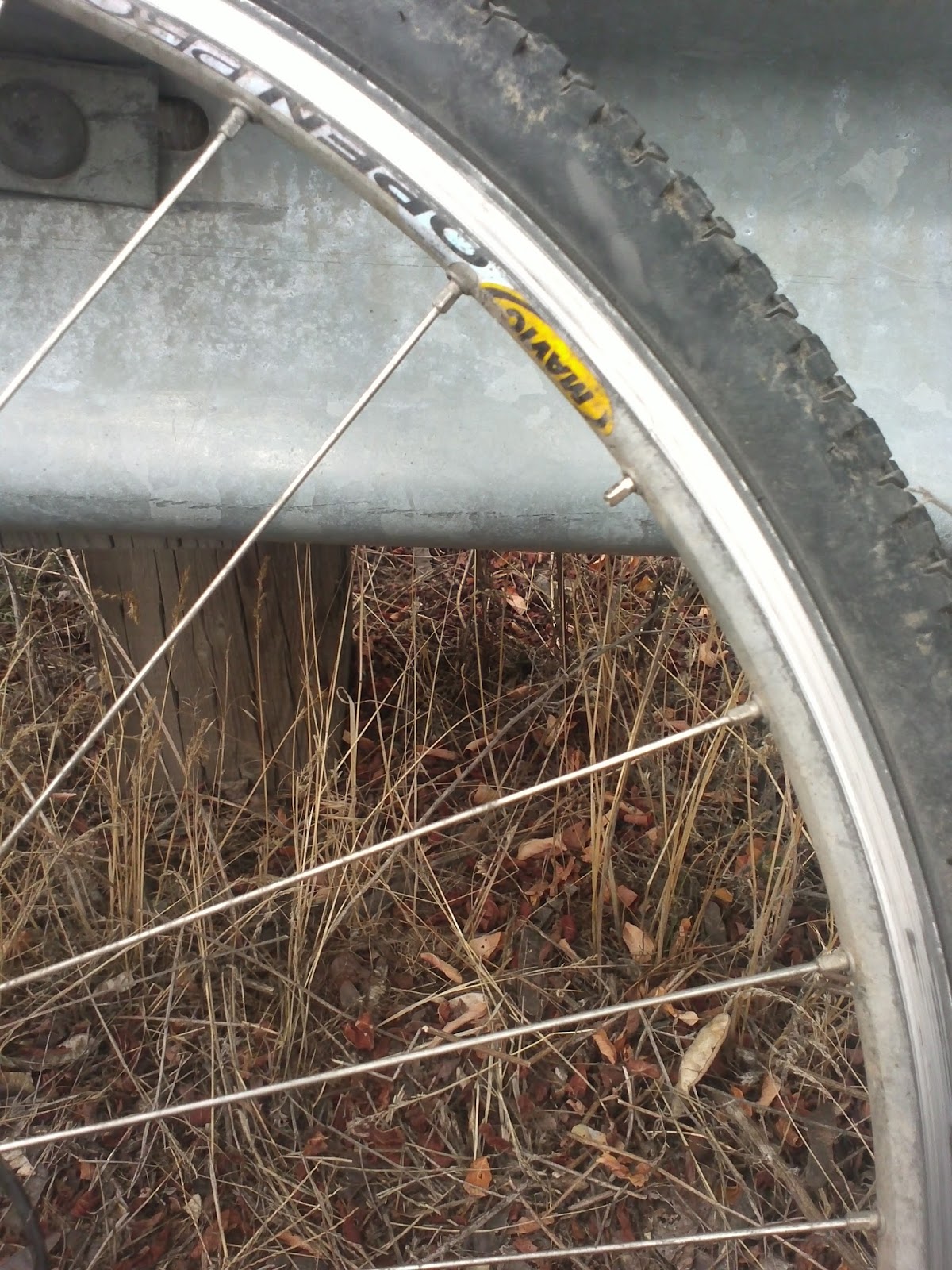
Two years ago this month, I bought Rory's Legolas. I also bought a new rear wheel for it. You can see the 2-year-old versions of the bike and wheel here. The wheel was a J&B deal: Mavic Open Pro laced to an Ultegra hub with butted DT spokes -- 32 hole. That's a sensible wheel and it's a great deal. Google shows these wheelsets all over the internet for super reasonable prices.


If a customer doesn't go with a custom Matt wheel, then Glen typically puts this wheelset on a lot of his Elephant bikes. It's a good wheelset, already!

Anyway -- I abuse the shit out of that poor Legolas. And I ride it a ton. I've been in and around 200 lbs for the last couple years and I don't ride lightly. The Legolas's main job in life is to get me around the High Drive trails or other local trails; its secondary job is to get me to those trails. It's a rough life. While the trails I ride on the Legolas are not super droppy-downhilly, they are technical, rocky, rooty, sandy, and steep. My point here is that this wheel has done hard time over the last two years.


So, when I heard the tell tale tink tink tink of a broken spoke today -- after hammering down the bluff trails to Sandifur -- I wasn't super surprised. The broken spoke was on the non-drive side, so the wheel didn't even wobble. In fact, it was amazingly true for a wheel with a broken spoke.

Given the lack of wobble, on the way home I decided that I'd fix the broken spoke with a FiberFix spoke. I've carried a FiberFix in my tool kits for at least 6 years and I've never used one. They've always looked sort of complicated and intimidating all wrapped up in their little plastic tube. So I figured hacking through the process in the comfort and safety of my garage would be good practice should I ever need to actually deal with one in the wild.


The FiberFix process was trivial. TRIVIAL. It took about five minutes and would've taken the same amount of time out in the dirt. The directions are excellent. I can't believe how easy it was.

If you don't have a FiberFix spoke in your stuff you should get one. Because now that you've read this, and therefore armed with this knowledge --  if you ever have to call in for a ride due to a broken spoke, you suck. They're like $6. And I got nothing going here as I shill these things -- they just rule.

Oh. And they're reusable. Crazy.


I'm going to ride that wheel until another spoke breaks or until the FiberFix fails. If another spoke breaks, I think I'll replace that one with a FiberFix too.