Friday, February 29, 2008

Euclid Road - The Dirt One

I've always wanted to check out the area up on the cliff just west of the Riverside State Park. From the Centennial Trail around RSP, you can see the homes up on the cliff overlooking the valley below. I found the road. There's a road up there called "Indians Bluff Road." I should've guessed. It's your typical run of McMansions on the hill. I saw your basic 4000 square foot monstrosities that are loosely based, architecturally speaking, on various styles: the Tuscan Turd, the Modern Box, the NW Rugged Getaway. No matter, since all of these sprawling homes are fortressed with various types of tall gates and walls that scream fear and paranoia far louder than the pseudo styles they attempt to emulate.
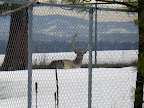


I'm pretty sure this poor dude was trapped; he was so listless. Or maybe he's their pet? Regardless, he wasn't acting very deer-like as I stood there and photo'd him. The maze of fences surrounding this house was incredible. And they were high.

Anyway, of course Indians Bluff Road is a dead end that terminates in a gated private community. The first house in here was a straw bale house going up. The sign out front said "Sustainable Building." Yeah.

Luckily, backing out of Indian Bluffs Road is downhill, so I made a conscious effort to flush the foul mood that these kind of neighborhoods always put me in.

I focused on this charmer at the cross roads of Euclid and Indian Bluffs Road.


As far as I can tell, it's still being operated as a school.


Euclid Road continues west to Heyford Road, which takes you to Airway Heights. Euclid has some nice dirt patches and there's likely some more dirt roads out here worth exploring. The West Plains is an area that I have not ridden much.
Coming back into town from Airway Heights, I took the Sunset Highway. The piece that comes into town from the junction of Highway 2/Sunset should really go on a road diet. We could have a great route to/from the airport if this section of Sunset Highway was turned into two lanes (instead of four) with a turn lane and big fat bike lane shoulders. All that space made sense when this road was the interstate back in the 50's, but now, with I-90, the traffic volume is just nothing.

Tuesday, February 26, 2008

Coming Soon

Cool idea.

Going in a couple doors down from the zip trip at 57th & regal.

Thanks to Jeff at fbc for the head's up.

This is a mobile blog post.

Ready to Ride


Last weekend I had planned to go on my first S24O of the season. I watched the night time temps all week in hopes that I'd get a break. I didn't. I'm good sleeping outside to about 40F; below that, it's not much fun anymore. It's been below freezing every night and I'm just not up for the suffering or hauling tons of crud to minimize the suffering. So instead, I stayed home and caught up on my list of bike fixes that I've been letting go.

The picture above shows all but one of the bikes I made fixes/changes to. From left to right, on the RB1, I swapped out bars, stem, cranks, bottom bracket; on the RB-T swapped out bars, removed fenders, rack to make this years trails/mountain/CX bike; on the Miyata, I put cruiser bars, replaced the chain and pedals; on the blue Univega, I finished a build that's been lingering for a month or so.


The Univega was a donation to Pedals2People. I think it was a frame only. Or maybe the bits that were on it were trashed. Either way, the son of the folks that donate the P2P garage space needed a bike, so we fixed this 0ne up for him.

Over the last couple days there has been an interesting discussion on the iBOB list about how to design a good city bike. The main thread is here. One post yesterday hit the nail on the head around designing good bikes. He mentioned that there were a few critical similarities between the "sport" tourers of the 70-90's; the universal Japanese bikes (UJB) of the 80's-90s, and the interesting French bikes from the 40's on: they all were made of good quality steel tubing; they took fattish tires; they had attachments for things like fenders and racks. Namely, these bikes were versatile. We've heard this before; that under a skilled rider, a versatile bike is all one needs. It's true.

This Univega is such a bike. We set it up as a commuter. It's got Armadillo tires on it so Don will never get a flat; it's got a rack; it's got fenders; it's got a reasonable spread of gears; it's reliable, light, simple, comfortable, and it's really fun to ride. All Don needs to do is get some lights and he's got a bike he can commute on every day.

It's hard to find versatile frames like this today. Off the top of my head, I can think of Bianchi and Jamis that have similar frames. The Surly Long Haul Trucker is another. There may be something by the Soma's and other smaller mass producers. After that, you're moving up the price ladder: Rivendell sells a frame like this. And any custom guy will make you one. But the point is, in a market flooded with speciality mass-markety bikes, finding a good versatile frame like this once-ubiquitous Univega is a task. That's a bummer.

Sunday, February 24, 2008

An Important Route


View Larger Map

In this month's issue of Out There Monthly, I wrote a column about the Iron Bridge. The bridge is a hugely important connection to hook up East Central to downtown for bike/ped traffic. In the map above, I've traced out a route that I think is probably one of the most important bike routes the city could attempt as we build the Master Bike Plan.

The neighborhoods of East Central and Chief Gary can be difficult neighborhoods to traverse by bike. The river, active rail lines, Trent, Sprague, and Mission avenues are just a few of the giant obstacles that make this part of town difficult to get through by bike. Putting in the Iron Bridge is a huge first step to transforming this area, but it's not the only thing that needs to get done. The city needs to capitalize on all of the core pieces of infrastructure that it already owns, and hook them together with the route above.

Moving counter clockwise from the Iron Bridge, go south on Helena. This stretch of road is huge and pretty light traffic. It would be easy to fit bike lanes here and preserve parking and still have room for car traffic. There's a light at Trent, so crossing there is pretty straight forward.


Then east on Riverside: shared/signed roadway to Altamont, where you go north a block to the Playfair site. The Playfair site is so cool. Last I heard, the city is thinking of a prison here. That is so awful and is the last thing that this already-struggling neighborhood needs. Anyway, the city owns this. There should be a big fat multi-use trail through here to the east end where the route would cross Fiske over the tracks.


The Fiske street foot bridge is another hidden gem: a safe/existing way over the huge gash that is the otherwise uncrossable live railroad. This is a hugely valuable piece of bike/ped infrastructure that is already used by commuters today.

Now, the piece from the Fiske bridge to Riverton/SCC is still murky to me. I've ridden around out here and I need to ride the piece that I show here. Crossing Trent here is no picnic and would cost some money to do right, but there are no other lights for at least 1/4 mile in each direction, so there would not be any issue with back ups if you put a ped/bike-friendly signal here.

Once you get to SCC, you can follow the trail that parallels Riverton Ave (amazingly, once again: a critical and valuable piece of infrastructure owned by the city; this is a river front trail we're talking about here -- the city has an easement). Follow the trail back to the city core, where you hit Mission and another live railroad trestle before you connect back with the Iron Bridge.

Aside from the Iron Bridge, going under the Mission street bridge and the other live trestle, are surely the most expensive infrastructure pieces in this route. But doing so makes a clean shot to SCC: from downtown to SCC all on multi-use (no traffic) trails.

This route would open up the East Central, Chief Gary, and Logan neighborhoods to bike and ped through traffic. I think this route would also improve the property values and private investment along the route. Today, traversing east/west through the core of our city by bike is not something new cyclists are likely to try.

Thursday, February 21, 2008

Porteur for the Masses

Joel Metz's Kogswell P/R. Click the pic to to Joel's site.

I'm not sure if this is a prediction or a hope or just wishful thinking, but here it is: I think 2009 or 2010 will deliver a mass-produced porteur-style bicycle. By "mass-produced," I would like to think Trek or Specialized, but I'm not that delusional. My buddy Alex has put his money on Surly or Raleigh. Raleigh may be a good bet considering the interesting bikes they've put out in the last couple years, namely the low-trail One-Way and the tourer/uber-commuter, Sojourn -- both of which ship with a Brooks saddle.

Anyway, here's why I think a porteur is ready for the mass market. I think it's an ideal "first adult bike" bike. By that, I mean, the porteur, if executed correctly, could be the bike that the 18-35 year-old, non-bikey folks would buy to run errands and be comfortable with for longer rides. And I think you could do it right for around $1000.

To be clear: I'm not talking about a take over of the mass produced comfort bikes, really, I'm talking about a blip on the overall industry of mass-retail bikes. But look what's happened with fixed gear bikes. Just about every mass-manufacturer has a fixed bike in the game now; just because they are shipping as single-speeds, doesn't alter the fact that the aesthetic/drive behind the bikes is the fixed sub-culture. Let's just hope that the mass producers don't over style the bike as they have with the fixed thing and forget the elements that make a good porteur work: namely low-trail and integrated front rack.

But, for style, the porteur delivers. Check out Joel's bike in the picture at the top; the classic porteur-style bars, reverse brake levers, front rack. It just looks cool, not mean-racey-gonna-intimidate-you-cool, but sensible, urbane, and smart cool.


Alex Wetmore's Kogswell P/R

While the bars, levers, and rack look cool, they also are designed for hauling loads up front. Put a net up there and your messenger bag or any bag, and the bike handles amazingly well with a load. People that buy the porteur can begin to replace short car trips the day they bring this bike home.

Joel's bike doesn't have this, but I think it's important: the bike should ship with an internally geared hub for zero-maintenance and ease of use. Again, talking to Alex about this online, he's convinced that the Nexus 8spd or the Sram 7 speed are the money hubs for this bike. Jamis has shown you can package the nexus in a mass-produced bike and still keep the cost down. In fact, Alex points to the Breezer Uptown as a good example of a bike with an internally geared hub and a generator hub-driven light for the $1100 price point.

The integrated fenders are a requirement as is a generator hub and light. The tires should be slightly puffy for a comfortable, but quick ride. Unlike a "comfort bike" or even the style of the Breezers, which, in my opinion sit you too much upright and make longer trips (>5 miles or so) arduous, a well-designed porteur puts you in a position on the bike that is suitable for longer rides.

Seems like this could ship for the $1000 price point if spec'd smartly.

If we get the Trek Porteur, let's remember where this started as we read the finely honed PR for it: this bike started with the French. In the 30's or so.

But looking at the history in the US, Joel Metz has been riding these bikes for over a decade. He has thrown in tons of input into Kogwell's design of the P/R, which is the first non-custom production versoin of the Porteur. It would be hard to imagine the P/R at all with out Alex, Mark, and Jan at Bicycle Quarterly publishing a bunch of data, photos, and history of the porteur design. Really, the Kogswell P/R has started the grassroots movement of a production porteur, and Matthew Kogswell deserves credit for actually sticking to it and bringing this bike to market.

This last shot is Adam Alpern's Kogswell P/R. Click the pic to go to his Flickr site -- great photos and great hand-made messenger bags.

Wednesday, February 20, 2008

A Chunk of Valley Chapel Will Be Closed This Summer


This just in from the city engineer...

Spokane County has scheduled a bridge replacement project on Valley Chapel Road in 2008. This project will close Valley Chapel Road to all traffic. Valley Chapel Road will be closed 1/4 mile north of Spangle Creek Road starting in April and is expected to be open by November of 2008.

So there's that.

Dirt roads are more fun anyway. Here's one for ya.

***Mid-day Update ***

Oh yeah....

And remember: FBC ride tonight.

Details here.

Monday, February 18, 2008

Too Bad Lance Isn't From Spokane

He's building a bitchin' bike commuter station in his hometown of Austin.

Spokane is ready for this. I want this so bad that it hurts.

Picture a building downtown or on the edge of downtown that is the hub of all things bike related.

You could run it like a co-op, where different bike-friendly/related renters that occupy different portions of the building.

Maybe the anchor would be a full service bike shop, where you could buy new stuff and get your bike serviced by professional mechanics. Another piece would be the DIY shop where mechanically-inclined folks could rent shop space by the 1/2 hour and fix their own bikes. Another piece would be a small coffee/cafe place. Another piece would be a bikestation, where bike commuters could rent space to store their bikes and where they could rent a locker and have access to a shower.

Fill up the small office spaces by renting to other bike folks: the Bike Alliance of Washington, P2P, Spokane Bike Club, Inland NW Trails Coalition, and any other bike-related or bike-friendly organization that needs space.

This space could transform a neighborhood that is on the cusp. It would be that third place cyclists in this city need.